Somatic Experiencing® + NeuroAffective Touch®
Healing that reaches the places talk therapy can’t.
You already know why you’re here.
You’ve spent time, probably years, learning yourself. You understand your patterns. You can name your triggers, trace your history, explain your reactions with real clarity. That work matters and it isn’t nothing.
But somewhere along the way you hit a wall. The understanding stopped translating into change. You’d have a breakthrough in a session and feel it for a few days, and then the anxiety would come back. The tension in your body would return. The old patterns would fire, and you’d be right back where you started, a little more exhausted, a little more doubtful that anything was ever really going to shift.
That wall isn’t a sign that you haven’t worked hard enough. It’s a sign that you’ve reached the edge of what the mind can do on its own.
The body is the next frontier. And this is where that work happens.
Somatic Experiencing®
What it is and how it works
Somatic Experiencing® (SE) is a body-centered, nervous system approach to healing trauma and chronic stress. It was developed over 45 years by Dr. Peter Levine, PhD, and it is one of the most rigorously researched trauma modalities in the world.
SE works from the bottom up, through the body rather than the mind.
Here's what that means. When we experience trauma or overwhelming stress, the nervous system activates a survival response: fight, flight, or freeze. In a healthy cycle, that response completes and the body returns to regulation. But when the experience is too intense, too prolonged, or too alone, the cycle doesn't complete. The survival energy stays stored in the body, as tension, hypervigilance, shutdown, chronic pain, or emotional reactivity, long after the original event has passed.
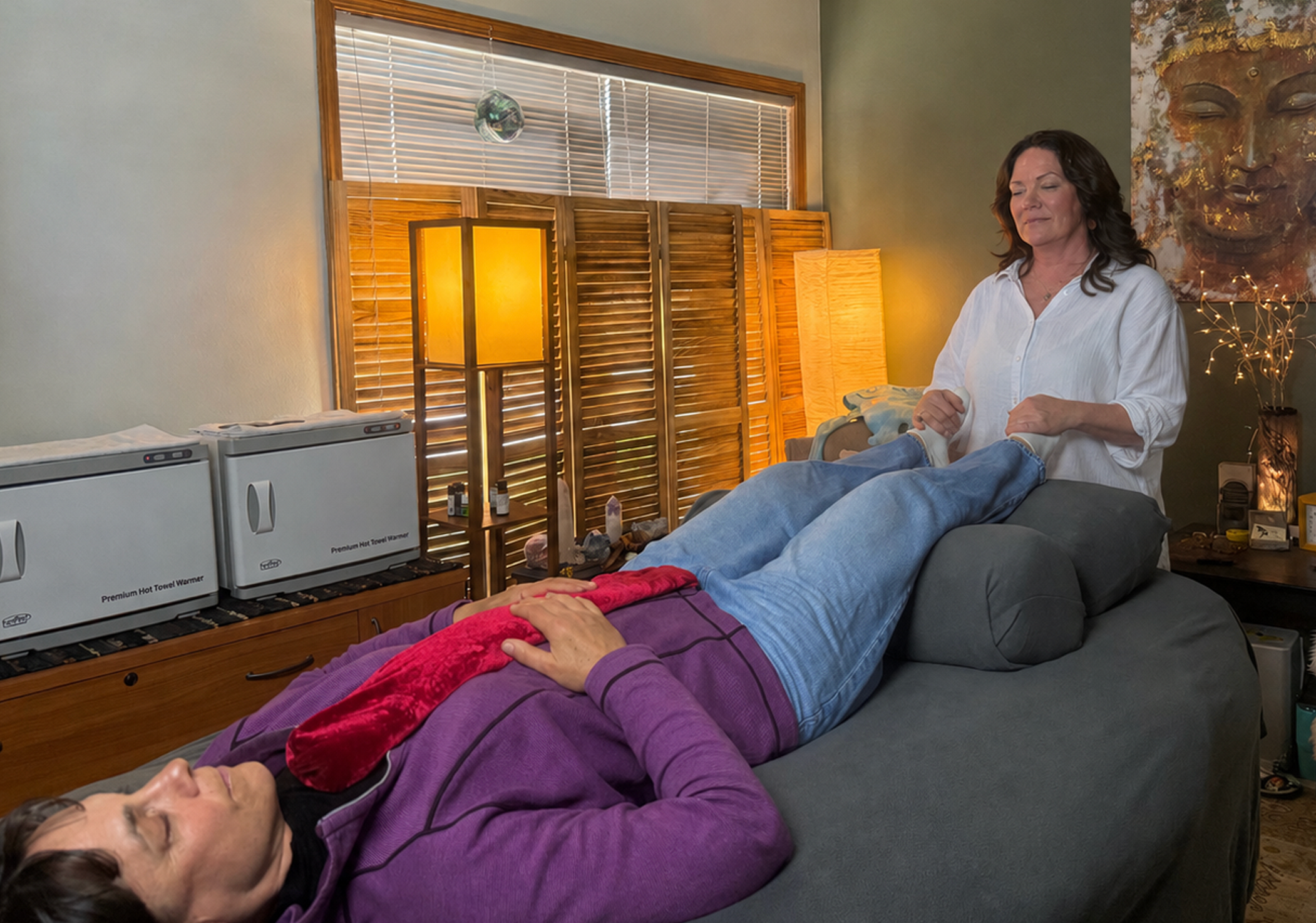
SE gently, carefully tracks these held states in the body. It works with sensation, movement, and breath to help the nervous system complete what it couldn't finish. It doesn't require you to retell your story or relive what happened. It works with what your body is holding right now.
The result, over time, is a nervous system that can return to its natural state: regulated, resilient, and present.
I am a certified Somatic Experiencing Practitioner (SEP) through Somatic Experiencing International, a 3-year, rigorous certification process. I've been doing this work for 35+ years, and SE is the foundation of everything I offer.
For people who’ve spent years understanding their patterns without being able to change how their body responds, this is why. The understanding lived in the mind. SE works where the wound actually lives.
NeuroAffective Touch®
The healing language of safe contact
NeuroAffective Touch® (NAT) was developed by Dr. Aline LaPierre, and it is one of the most precise and powerful complements to SE work available.
NAT is a polyvagal-informed, psychobiological approach that uses gentle, consensual, fully clothed touch as a bridge to body-mind integration.
Touch is a language the nervous system understands before words exist. Before we had language, we had contact. The felt experience of safe, attuned physical presence is one of the most fundamental ways the nervous system learns that it is not alone, and that it is safe.
For many people, especially those with developmental trauma, early attachment wounds, or a history of feeling unsafe in their own body, touch carries real complexity. NAT is not casual or incidental. It is precise, consensual, and always in service of your nervous system's regulation. Nothing happens without your full awareness and agreement.
Where SE works primarily through verbal tracking of sensation and nervous system states, NAT adds what SE alone cannot always reach: the pre-verbal, developmental layer of the wound. The place that formed before you had words for any of it.
Peter Levine himself has endorsed Dr. LaPierre's work. That means something.
If you’ve ever felt like there’s a layer of your experience that words simply can’t reach, a place that formed before you had language for any of it, that’s the layer NAT is designed for.
Why SE and NAT Together
The integrated approach
SE and NAT are not two separate offerings. In my practice, they are one integrated approach.
SE works with the nervous system's survival responses, the dysregulation that formed in response to specific overwhelming experiences. NAT works with the deeper developmental and attachment layer, the patterns that formed early, before memory, in the fabric of how you learned to relate to yourself and others.
Together, they reach the full spectrum of what the Self-Aware Survivor is carrying.
SE helps your nervous system complete the survival cycles that got stuck. It addresses the anxiety, the hypervigilance, the freeze, the chronic activation.
NAT helps your nervous system learn what safe contact, safe presence, and safe relationship actually feel like in the body, not as a concept, but as a lived experience.
Many people have hit a ceiling in talk therapy or even in SE alone because the wound they're carrying isn't primarily cognitive or even event-based. It lives at the pre-verbal, somatic level of early relationship. NAT is how we reach that layer.
In Northern Nevada, this specific integrated combination, SE and NAT offered together by a practitioner trained in both, is rare. I believe it is exactly what many people who've felt stuck in their healing have been looking for without knowing it existed.
If that’s you, you’re in exactly the right place.
This might be exactly what you’ve been looking for
This work is for you if:
You've spent years in therapy and developed real insight, but your body still hasn't caught up with what your mind understands.
You experience anxiety, chronic tension, hypervigilance, emotional flooding, shutdown, or dissociation, and you've tried many things, with limited lasting change.
You feel the imprint of old experiences in your body and you're ready to work at that level.
You want a healing approach that is gentle, collaborative, and deeply respectful of your nervous system's pace.
You've been told you're "too sensitive" or "too reactive" and you're ready to understand that as information, not a flaw.
You're tired of managing your symptoms and ready to work toward actual regulation.
You don't need a specific traumatic event or diagnosis to benefit from this work. Many of my clients carry what is called developmental trauma or small-t trauma, the accumulation of chronic stress, early relational wounds, and nervous system dysregulation that never had a single identifiable cause. SE and NAT work beautifully for this.
What a session actually feels like
I want to be honest with you about what this work is and isn't.
It is not dramatic. It is not cathartic release or emotional flooding. It does not require you to revisit painful memories or tell your story in detail. In fact, we actively avoid re-traumatization.
What it is, is quiet and precise. And often profound.
In a session, we slow down. We pay attention together to what is happening in your body right now, sensations, impulses, images, breath, movement. I guide you through that with care and curiosity, not urgency.
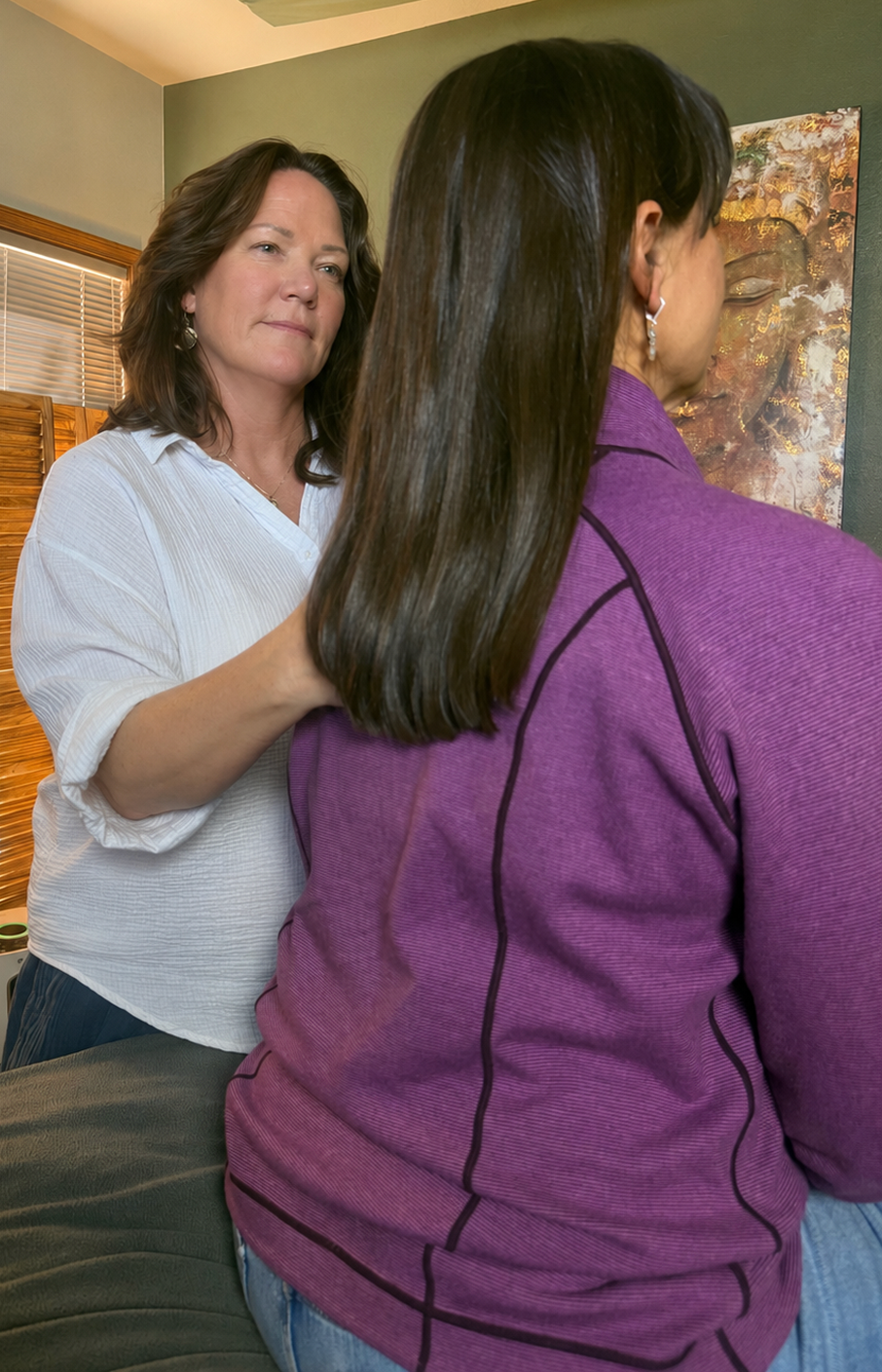
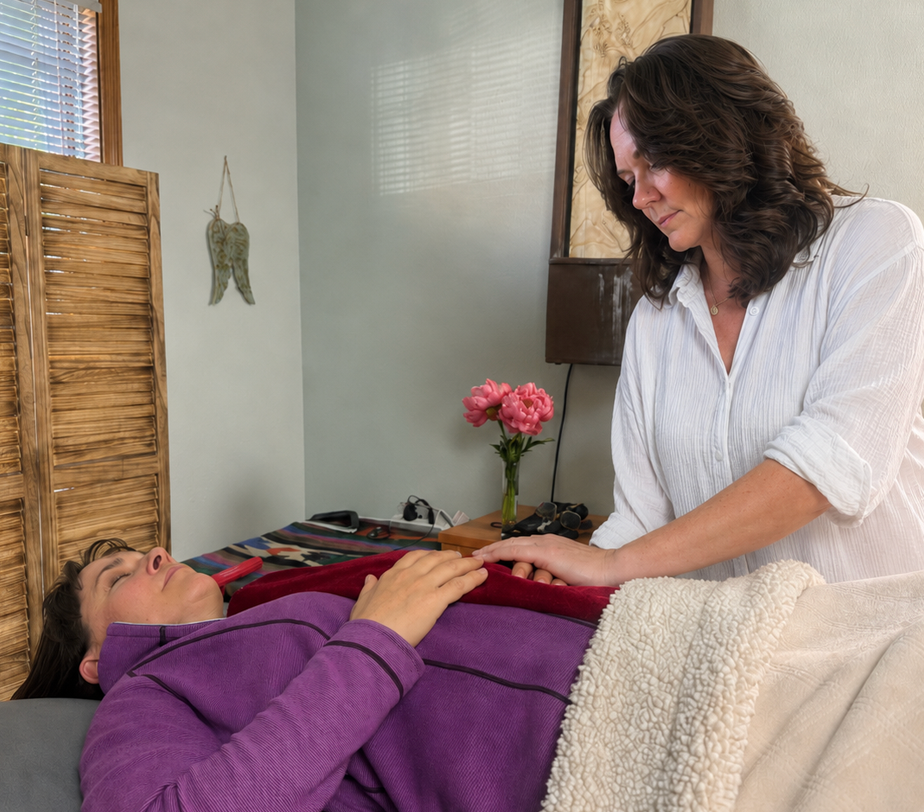
Sessions are fully clothed. When NAT touch is introduced, it is always explained, offered, and consented to before it happens. You are always in the lead. Your nervous system sets the pace.
Many clients describe sessions as feeling both deeply restful and subtly activating at the same time. Things shift. Not because you forced them, but because your nervous system was finally given the conditions to complete what it started.
The changes tend to accumulate over time. Most clients notice something after the first session, a quality of settling, or a moment of unexpected ease. The deeper shifts unfold over weeks and months, as your nervous system builds new capacity.
How this is different from talk therapy, EMDR, and general bodywork
Compared to talk therapy: Talk therapy works top-down, from the mind. It builds understanding, insight, and cognitive frameworks for making sense of your experience. That work has real value. But insight does not change the nervous system's physiology. SE and NAT work bottom-up, through the body, which is where the dysregulation actually lives.
Compared to EMDR: EMDR is a powerful and well-researched modality. It works with specific traumatic memories and uses bilateral stimulation to reprocess them. SE and NAT do not require a specific traumatic memory. They work with the nervous system's current state and held patterns, which makes them particularly well-suited for developmental trauma, complex trauma, and chronic dysregulation without a single identifiable event.
Compared to general massage or bodywork: General bodywork is wonderful for relaxation and physical tension. NAT is something different. It is psychobiologically informed touch used specifically in service of nervous system regulation and integration. Every touch has intention, awareness, and clinical purpose behind it.
You don’t need a dramatic story to be here
Anxiety that doesn't respond to cognitive techniques. Panic that arrives without a clear trigger. Chronic tension in the body that doesn't resolve with massage or exercise. Emotional numbness or disconnection. Difficulty feeling safe in relationships. Hypervigilance. Chronic pain with no clear structural cause. A history of trauma or adverse childhood experiences. The sense of being stuck even after years of good therapeutic work.
You do not need a diagnosis. You need a body that is ready for something different.
Session structure and pricing
First Session, 90 minutes, $150
Your first session includes a full intake conversation so I can understand your history, your goals, and what you're working with. We will also begin the work together. Most people leave the first session having already experienced something of how SE and NAT feel.
Recommended Starting Point
I suggest beginning with 5 sessions within your first 6 to 8 weeks. After that, we reassess together. Many clients continue weekly, biweekly, or monthly for as long as it's useful.
Sliding Scale
Please don't let finances get in the way of your healing. Let's chat.
Testimonial
“After years of struggling with anxiety, self-hate, and body image issues, this was the first approach that truly helped me understand why I felt the way I did. Marta created a space where I felt safe, understood, and supported. Because of this work, I feel calmer, more grounded, and well into the healing process.”
-Anonymous, 65 year old Female
Learn more, podcasts and video
If you want to understand SE and NAT more deeply before we talk, these resources are excellent.


Ready to begin?
If something on this page landed, if you recognized yourself somewhere in these words, I'd love to talk.
The next step is a free 30-minute consultation. No pressure, no commitment. Just a conversation to see whether this work feels right for you, and whether we're a good fit.