What to Expect
Ready to begin? Here’s everything you need to know.
No mystery, no pressure, just a clear path from where you are to where you want to be.
Starting something new, especially something that asks you to trust your body again, takes courage. I want to make this as straightforward as possible. Below you'll find everything about how we work together, what to expect, what it costs, how the process unfolds, and answers to the questions I hear most often.
If something isn't answered here, please reach out. I'd rather have a conversation than have uncertainty keep you from your healing.
How we work together
-
Before anything else, we talk. This is a no-pressure conversation to help us both get a sense of whether this work and this relationship feel like a good fit. You can ask me anything. I'll ask you a few questions about what you're working with and what you're hoping for. There's no commitment on either side.
-
In your first session I want to understand your history, your nervous system's patterns, what has and hasn't worked before, and what you're carrying right now. We also begin the work itself in that first session, most people leave having already had a felt sense of what SE and NAT actually feel like in the body.
-
I recommend starting with 5 sessions within your first 6 to 8 weeks. This is enough time for the nervous system to begin building new capacity, for us to establish real safety and rhythm together, and for you to start noticing tangible shifts. It also gives us both enough information to assess together how the work is landing and what you need next.
-
After those first sessions, we check in. How is the work feeling? What has shifted? What do you want to go deeper with? Some clients continue weekly. Others move to biweekly or monthly as their nervous system stabilizes. You set the pace, I follow your lead.
-
Many of my clients work with me for months or years, not because they're stuck, but because they've found that ongoing somatic work continues to open new territory. Others complete a focused arc and feel complete. Both are right. This is your healing, on your timeline.
Investment
I believe healing should be accessible. Here is exactly what sessions cost.
All Sessions · 90 minutes · $150
Sliding Scale
Please don't let finances get in the way of your healing. Let's chat.
I hold a small number of sliding scale spots. If cost is a barrier, reach out and we'll find something that works. I'd rather have that conversation with you than have you walk away from something that could genuinely change your life.
Questions I hear most often
-
Yes, and honestly, this work is often most powerful for people who have. If you've done significant talk therapy, you've built real self-awareness and cognitive tools. That foundation matters. What SE and NAT add is access to the layer of the nervous system that talk therapy can't reach directly, the physiological, pre-verbal level where survival patterns live. Many of my clients come to me after years of good therapeutic work precisely because they've hit a ceiling and sense that the next level of healing has to happen somewhere other than the mind.
-
No. You don't need one. Many of the people I work with don't have a single identifiable traumatic event. What they have is what's often called developmental trauma or complex trauma, the accumulated effect of chronic stress, early relational wounds, childhood environments that weren't safe or attuned, or simply a nervous system that learned to stay on high alert because that's what kept them safe. SE and NAT work beautifully for this. You don't need a diagnosis. You need a body that's ready for something different.
-
That's worth talking about before we begin, and I'm glad you'd raise it. Touch in NAT is never assumed, never automatic, and never required. It's always offered, explained, and consented to before it happens. Many clients begin with exclusively verbal SE work and introduce touch gradually, as trust builds and it feels right. Your comfort and safety set the pace, always. If touch feels like a barrier right now, that's not a reason to avoid this work. It may actually be one of the most important reasons to explore it, at whatever pace makes sense for you.
-
If you've done talk therapy, EMDR, general massage, yoga, or meditation, you've worked with pieces of the picture. What SE and NAT offer is a body-centered, nervous system-focused approach that works directly with the physiological patterns underneath your symptoms, not just the thoughts and stories about them, and not just the surface tension in your muscles. The combination of SE's nervous system tracking with NAT's attuned touch reaches a layer of healing that most approaches don't access. For people who've done a lot of work and still feel stuck, this specificity is often what makes the difference.
-
It's a fair concern, and I want to give you an honest answer. SE is specifically designed to avoid re-traumatization. We work carefully, titrating the process, meaning we take very small steps and always stay within your window of tolerance, the range where your nervous system can process without becoming overwhelmed. We don't go digging for memories. We don't deliberately induce emotional flooding. If something difficult comes up, we slow down, resource, and work with it carefully. Over 35+ years, the most consistent thing I've seen is that when the work is done well, paced correctly, with genuine safety between practitioner and client, it feels surprisingly gentle, even when it's going somewhere deep.
Testimonial
"After 23 years in law enforcement, I came to Marta carrying PTSD, deep guilt, childhood trauma, and a body still holding the pain of being shot on the job. I had tried talk therapy, EMDR, and a trauma retreat, but nothing gave me lasting relief. Through Somatic Experiencing with Marta, I was finally able to release the emotions I had been carrying, find closure from my childhood traumas, and learn to forgive myself. The guilt is gone. In its place, I have joy and peace."
-Anonymous, Retired Law Enforcement Officer
About the sessions themselves
-
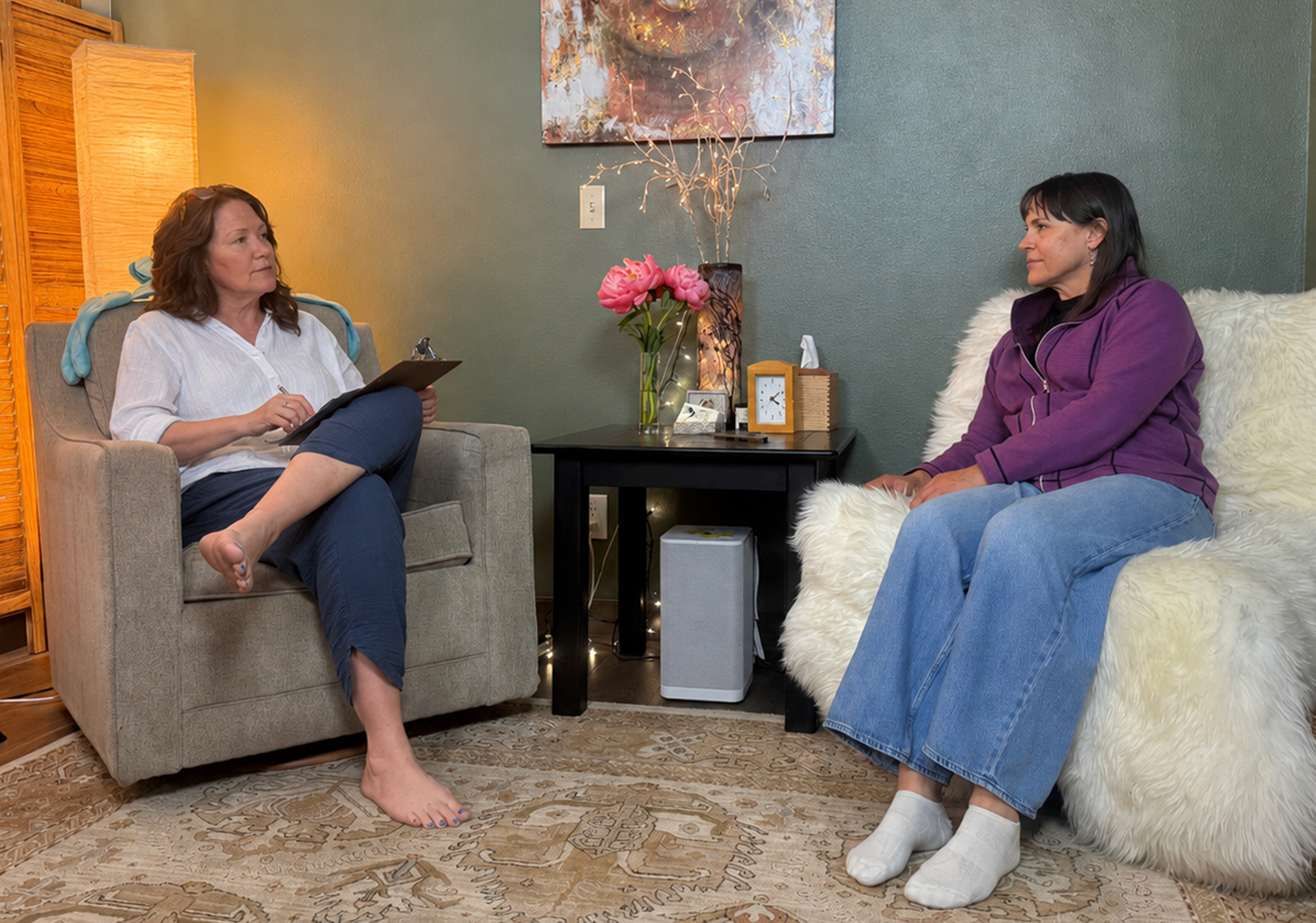
You'll be fully clothed throughout, and sessions are conducted in a quiet, private office. We begin by checking in, how you're feeling, what's been happening since we last met, what feels alive or activated in your body right now. From there, I guide you through a process of noticing, sensations, impulses, images, breath, areas of tension or release. We work slowly and attentively. When NAT touch is part of the work, I describe what I'm offering before I offer it, and you always have the option to say yes, not yet, or no. Sessions rarely look dramatic from the outside. What's happening is often subtle and always intentional.
-
No. You don't have to tell me what happened. Many clients share context over time as trust builds, and that context can be useful. But SE and NAT don't require your story in order to work. They work with your nervous system's current state, the patterns that are active right now, rather than with the narrative of the past. Some clients find this a profound relief. The body knows what it's holding. We work with that, at whatever level of verbal sharing feels right to you.
-
It varies, and it changes over time. After early sessions, many clients feel a quality of settling, a quietness or groundedness that might be unfamiliar. Some feel tired. Some feel subtly activated and need a little time to integrate before going back into a full day. I usually recommend giving yourself some buffer after sessions when possible, not diving immediately into a demanding meeting or a stressful environment. Over time, clients generally report that the integration feels easier and the shifts feel more stable.
-
All sessions are 90 mins. I recommend starting with weekly sessions for the first 5 visits. After that, many clients continue weekly, while others shift to biweekly or monthly as their nervous system stabilizes. We figure this out together based on what's working for you.
-
Comfortable, loose clothing. You'll be on a bodywork table or seated in a chair for the session. You'll stay fully clothed throughout.
-
Not at this time.
About Somatic Experiencing specifically
-
Most therapy works top-down, starting with thoughts, beliefs, and the mind's interpretation of experience. Bottom-up means we start with the body. We work with sensation, posture, breath, movement impulses, and the felt sense of experience in the nervous system, and from there, meaning and insight often emerge organically. The reason this matters is that trauma and chronic stress don't live primarily in your thoughts. They live in your physiology, in the patterns your nervous system learned in order to survive. Working bottom-up means working where the wound actually is.
-
Yes. Anxiety is, at its root, a nervous system phenomenon, a state of chronic activation that the system has learned to maintain. It doesn't require a specific traumatic origin to respond to SE. Many of my clients come in with what they'd describe as "just anxiety," no significant trauma, just a nervous system that never learned to fully settle. SE is highly effective for this. We work directly with the activation patterns, gently building the nervous system's capacity to regulate, which is the physiological foundation of lasting calm.
-
Yoga, somatic movement, and body-based exercise can be wonderful resources for nervous system regulation. SE is different in that it's a clinical modality, a specific, structured approach to trauma resolution developed and researched over 45 years, with a rigorous certification process. It's not a wellness practice. It's a therapeutic intervention for working directly with survival-response patterns stored in the nervous system. The two can absolutely complement each other, and many of my clients practice yoga or movement work alongside our sessions. But SE works at a different level of specificity.
-
The clinical definition of trauma is broader than most people realize. Trauma doesn't require a dramatic event. It's any experience that overwhelmed your nervous system's capacity to process and integrate, which includes many common human experiences: childhood illness, loss, relational ruptures, medical procedures, chronic stress, feeling chronically unseen or unsafe. If your nervous system developed patterns of hypervigilance, shutdown, or chronic activation that persist even when you're objectively safe, that's a nervous system that experienced more than it could handle. You don't need the label to benefit from the work.
About NeuroAffective Touch specifically
-
NeuroAffective Touch is a polyvagal-informed approach that uses gentle, consensual, fully clothed touch to support nervous system regulation and body-mind integration. Touch is a language the nervous system understands before words exist. It's the first way we learned to feel safe, or not, in relationship. For many people, especially those with early attachment wounds or developmental trauma, the experience of safe, attuned physical contact is itself therapeutic. It reaches a pre-verbal layer of healing that verbal work alone can't always access. NAT isn't massage, and it isn't incidental, every touch has clinical intention and purpose.
-
With great care, and only at your pace. Many clients come to this work with complicated histories around touch, and for some, learning to receive safe touch is one of the most important parts of their healing. We never introduce touch without explicit conversation and consent first. We build toward it gradually, only when the relational safety between us is solid, and only in the ways that feel right to you. You can say no at any point, for any reason, and it will never affect our working relationship. Your boundaries are not obstacles, they're information, and I follow them.
-
Yes. NAT doesn't require prior experience with somatic work. What it does require is a willingness to slow down, pay attention to your body's experience, and trust the process at whatever pace feels safe. Many clients begin with a mix of SE and very gentle introductory NAT work in their early sessions, building toward deeper touch work as comfort and familiarity develop.
Practical questions
-
The free consultation exists exactly for this. In 30 minutes, you'll have a real sense of what it feels like to talk with me, whether my approach resonates, whether you feel heard, whether the work sounds like something your system is ready for. I also encourage you to trust your gut. The therapeutic relationship is a significant part of what makes this work effective. If something feels off, it's okay to say so, or to take more time before committing.
-
That's completely okay. There's no long-term contract, no package you have to pre-purchase, no pressure to continue beyond what feels right. You can pause or stop at any point. I do ask that you give the work a fair chance, the nervous system typically needs at least 3 to 5 sessions to begin showing consistent change, but you are always the one who decides whether and how to continue.
-
Yes. I hold a 24 hour cancellation policy, which means cancellations made within 24 hours of our scheduled session require full payment. When I reserve time for you, I'm holding that space specifically for your nervous system and the work we're doing together. I'm not booking another client into that slot, and I'm preparing in advance for our session.
That said, I make a clear exception for illness. Please don't come to session when you're sick. Your body needs rest, and this work is most effective when your system has the capacity to engage. Just let me know, and we'll reschedule.
-
You don't need to do anything to prepare. Come as you are. If you'd like, you can spend a few minutes beforehand noticing how your body feels, any areas of tension, any quality of your breath, any emotions that are present. But this is optional. The most useful thing you can bring to a first session is curiosity and a willingness to slow down.
-
Yes. I am taking new clients.
Testimonial
“I came to Marta carrying a lifetime of trauma, injuries, emotional pain, and physical exhaustion. This work was new to me, but as we moved through the layers my body had been holding, I began to feel a calm unlike anything I had experienced before. Marta creates a quiet, safe space where emotion can be released and where I felt truly seen. I am now more confident, satisfied, and happy in my day-to-day life.”
-Anonymous, 60+ year old Male
The first step is a conversation.
If something on this page, or anywhere on this site, has felt like it was describing your experience, I'd love to talk. The free consultation is 30 minutes, there's no pressure or commitment, and it's just a chance for us to meet and see if this feels right.
You've been doing the work for a long time. You deserve a path that actually reaches where the wound lives.